
A few years ago, learning to program often meant buying expensive books, enrolling in costly courses, or attending a university. Today, things are very different. Anyone with a computer and an internet connection can find the best free resources to learn programming and get started without spending a dime.
Whether you dream of becoming a software developer, building websites, creating mobile apps, working in artificial intelligence, or simply learning a valuable new skill, there are excellent free resources available online. The challenge isn’t finding resources—it’s knowing which ones are actually worth your time.
Many beginners jump between dozens of websites and YouTube videos without making real progress. This often leads to frustration and eventually to giving up. A better approach is to choose a clear learning path and stick with the best free resources to learn programming, rather than scattering your time across too many options.
This guide is designed to help you do exactly that. Instead of overwhelming you with hundreds of options, you’ll discover beginner-friendly platforms that are trusted by millions of learners, along with practical advice on how to use them effectively.
By the end of this guide, you’ll know:
- Why programming is one of the most valuable skills you can learn
- How to choose the right programming language for your goals
- Which free websites are worth your time
- How to avoid common beginner mistakes
- Where to continue learning after completing your first courses
Let’s begin with why programming remains such a valuable skill in today’s world.
Why Learn Programming Today?

Programming is no longer a skill reserved for professional software engineers. Businesses, schools, startups, healthcare organizations, and even small local companies rely on software every day. As technology continues to evolve, programming knowledge has become useful across many industries.
While job opportunities and salary levels vary by country and specialization, software development remains an important career field. Before publishing, verify any employment or salary statistics using authoritative sources such as government labor departments or recognized industry reports.
Build a Career with Global Opportunities
Programming skills can open doors to careers in areas such as:
- Web development
- Mobile app development
- Data analysis
- Artificial intelligence
- Cybersecurity
- Cloud computing
- Software engineering
- Game development
Many companies also hire remote developers, allowing people to work with international teams without relocating.
Start Freelancing
Programming is one of the most in-demand freelance skills. Freelancers often build:
- Business websites
- Online stores
- Automation tools
- Mobile applications
- APIs
- Custom software
As your experience grows, you can take on larger and more complex projects.
Build Your Own Projects
One of the biggest advantages of learning programming is the ability to create your own ideas instead of waiting for someone else to build them.
For example, you could create:
- A personal finance tracker
- A study planner
- A portfolio website
- A task management app
- An online calculator
- A blog
- A business website
Building real projects is also one of the best ways to improve your skills.
Improve Problem-Solving Skills
Programming teaches you how to think logically.
Instead of memorizing information, you’ll learn how to:
- Break large problems into smaller ones
- Find patterns
- Test different solutions
- Debug mistakes
- Think step by step
These problem-solving skills are valuable even outside software development.
Understand Modern Technology
Technology is becoming part of everyday life. Understanding programming can help you better understand:
- Artificial intelligence tools
- Websites
- Mobile apps
- Automation
- APIs
- Cloud services
Even if you never become a professional developer, programming knowledge can help you work more effectively with modern technology.
How to Choose Your First Programming Language
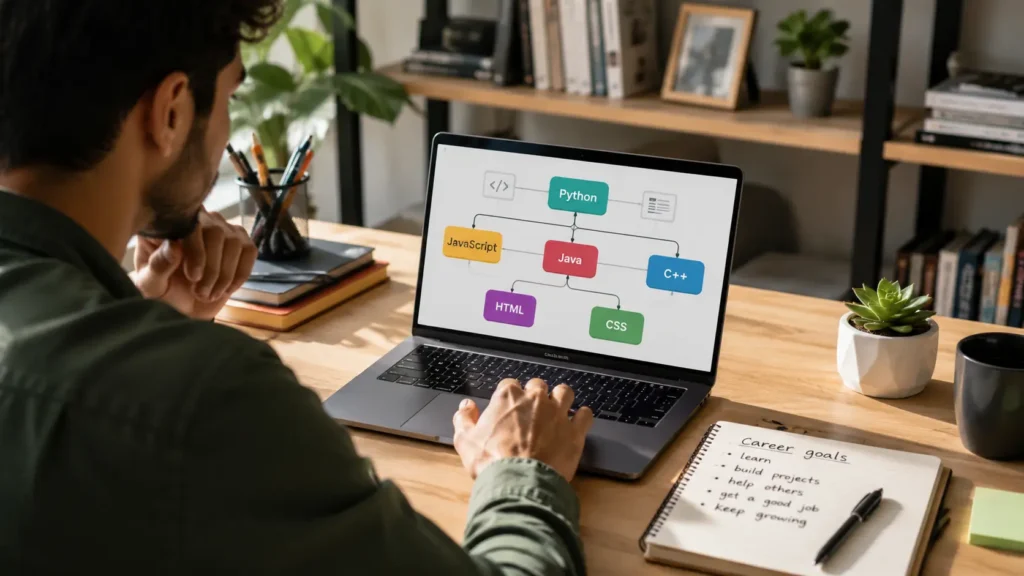
One of the biggest mistakes beginners make is trying to learn several programming languages at once.
Instead, choose one language based on your goals. Once you understand programming fundamentals, learning additional languages becomes much easier.
If You Want to Build Websites
Start with:
- HTML
- CSS
- JavaScript
HTML creates the structure of a webpage.
CSS controls its appearance.
JavaScript adds interactivity and dynamic features.
This combination is the standard starting point for front-end web development.
Recommended for:
- Beginners
- Website creators
- Freelancers
- Future front-end developers
If You Want to Learn General Programming
Python is one of the most beginner-friendly programming languages.
Its simple syntax allows you to focus on programming concepts rather than complicated rules.
Python is widely used for:
- Automation
- Data analysis
- Machine learning
- Artificial intelligence
- Web development
- Scientific computing
Many beginners choose Python because it is easy to read and has a large learning community.
If You Want to Build Mobile Apps
Your language depends on the platform.
For Android development:
- Kotlin
- Java
For iOS development:
- Swift
If you eventually want to build apps for multiple platforms, you may later explore frameworks such as Flutter or React Native after learning programming fundamentals.
If You’re Interested in Artificial Intelligence or Data Science
Python is generally the first recommendation because many popular AI and data science libraries support it.
Once you’re comfortable with the basics, you can move on to topics like:
- Data visualization
- Machine learning
- Deep learning
- Natural language processing
If You Want to Build Games
Game development offers several paths.
Popular languages include:
- C#
- C++
- Python (for simple games)
- JavaScript (browser games)
Many beginners start with simple 2D games before exploring larger game engines.
If Cybersecurity Interests You
Many cybersecurity professionals learn:
- Python
- Bash
- JavaScript
- SQL
A strong understanding of networking, operating systems, and security concepts is just as important as learning a programming language.
A Simple Recommendation for Most Beginners
If you’re still unsure where to begin:
- Choose Python if you want an easy introduction to programming or are interested in automation, AI, or data.
- Choose HTML, CSS, and JavaScript if your goal is to create websites or become a web developer.
The most important decision isn’t choosing the “perfect” language—it’s sticking with one long enough to build real projects.
1) Best Free Websites to Learn Programming

The internet is filled with programming tutorials, but not every website is suitable for beginners. The platforms below are well known for their quality, beginner-friendly lessons, and active learning approach.
1. freeCodeCamp
Best for: Complete beginners and aspiring web developers
freeCodeCamp is one of the most respected free programming platforms available.
It offers structured learning paths that guide you from basic HTML to advanced JavaScript, responsive web design, databases, APIs, and more.
One of its biggest strengths is project-based learning. Instead of simply reading lessons, you’ll regularly build real applications that reinforce what you’ve learned.
Why do beginners like it
- Completely free
- Interactive coding exercises
- Hands-on projects
- Large learner community
- Portfolio-worthy certifications
If your goal is web development, freeCodeCamp is an excellent place to start.
2. The Odin Project
Best for: Future full-stack developers
The Odin Project provides a complete roadmap for learning web development.
Unlike many platforms that rely only on short coding exercises, it encourages learners to build real projects using professional tools and workflows.
You’ll also become familiar with technologies commonly used by developers, such as Git, GitHub, and command-line tools.
What makes it different?
- Project-focused curriculum
- Real-world development workflow
- Open-source community
- Practical assignments
- Strong emphasis on independent learning
If you’re serious about becoming a web developer, this platform can prepare you for real development work.
3. Harvard CS50
Best for: Learners who want a strong computer science foundation
Harvard’s CS50 course has introduced programming to millions of learners worldwide.
Rather than teaching only one programming language, it explains how computers work and develops problem-solving skills that apply across languages.
Topics typically include:
- Algorithms
- Data structures
- Memory
- Programming fundamentals
- Web development basics
The course is more challenging than many beginner tutorials, but many students find it rewarding.
Before publishing, verify the latest course availability and enrollment options through Harvard’s official CS50 website.
4. W3Schools
Best for: Quick references and beginner tutorials
W3Schools has been helping beginners learn web technologies for many years.
Its lessons are short, simple, and include interactive examples that you can edit directly in your browser.
You’ll find tutorials covering:
- HTML
- CSS
- JavaScript
- SQL
- Python
- PHP
- Bootstrap
- React
- Node.js
This makes W3Schools especially useful when you need a quick explanation or code example while working on your own projects.
Best use case
Don’t rely on W3Schools as your only learning resource. Instead, use it alongside project-based courses to reinforce concepts and quickly look up syntax or examples.
The next section of this guide explores additional outstanding free learning platforms, the best YouTube channels, coding practice websites, official documentation, and AI-powered tools to accelerate your programming journey.
2) Best Free Resources to Learn Programming
Best Free Websites to Learn Programming (Continued)
The platforms below complement the websites covered in Part 1. Each one offers a different learning experience, so choose the resources that match your goals and learning style.
5. Codecademy (Free Plan)
Best for: Interactive coding lessons
Codecademy is popular because you can write code directly in your browser while following step-by-step instructions. The free plan includes introductory courses in several programming languages, making it a good place to explore different technologies before deciding what to study in depth.
What you’ll learn
- Python
- JavaScript
- HTML & CSS
- SQL
- Basic web development concepts
Pros
- Interactive lessons
- Beginner-friendly interface
- Immediate feedback
- Easy to follow
Keep in mind
Some advanced courses, projects, and career paths require a paid subscription. Check the current free plan features before publishing, as they may change over time.
6. Khan Academy
Best for: Absolute beginners and younger learners
Khan Academy explains programming concepts in a simple, approachable way. Lessons are designed to build confidence gradually, making the platform ideal for learners who feel intimidated by coding.
Popular topics include:
- JavaScript basics
- HTML & CSS
- Computer science fundamentals
- Animation and interactive graphics
The platform also includes quizzes and coding exercises to reinforce what you’ve learned.
7. MIT OpenCourseWare
Best for: Computer science theory and university-level learning
MIT OpenCourseWare gives learners free access to course materials from the Massachusetts Institute of Technology.
You’ll find:
- Computer science lectures
- Programming assignments
- Reading materials
- Problem sets
While these courses are more academic than interactive, they’re an excellent resource for learners who want a deeper understanding of computer science.
8. Coursera (Free Audit Option)
Best for: Structured university courses
Coursera partners with universities and organizations around the world. Many courses can be audited for free, allowing you to access video lectures and reading materials without paying.
Topics include:
- Python
- Web development
- Data science
- Machine learning
- Software engineering
Before recommending a specific course, verify whether free auditing is still available, as pricing and access policies may change.
9. edX (Free Audit Option)
Best for: University-level programming courses
Like Coursera, edX offers courses from well-known universities.
You can study subjects such as:
- Introduction to Computer Science
- Programming fundamentals
- Artificial intelligence
- Data structures
- Cybersecurity
Certificates generally require payment, but many courses can be accessed for free through the audit option. Verify current availability before publication.
Best Free YouTube Channels

Video tutorials can make difficult programming concepts easier to understand. The following channels consistently publish high-quality educational content.
Programming with Mosh
Programming with Mosh is known for clear explanations and beginner-friendly teaching.
Popular topics include:
- Python
- JavaScript
- C#
- SQL
- React
- Git
His tutorials focus on practical coding rather than memorizing syntax.
Bro Code
Bro Code creates beginner-friendly tutorials with straightforward explanations and plenty of examples.
You’ll find videos covering:
- Python
- Java
- C++
- HTML
- CSS
- JavaScript
Many learners appreciate the relaxed teaching style and complete beginner courses.
Traversy Media
If you’re interested in web development, Traversy Media is an excellent resource.
Topics include:
- HTML
- CSS
- JavaScript
- React
- Node.js
- Next.js
- Git
- Web development projects
Many tutorials involve building real applications from scratch.
freeCodeCamp.org
The freeCodeCamp YouTube channel hosts long-form courses taught by experienced instructors.
You’ll find complete tutorials on:
- Python
- JavaScript
- SQL
- Machine learning
- Web development
- Data analysis
Many videos are several hours long, making them suitable for focused learning sessions.
CodeWithHarry
CodeWithHarry offers programming tutorials that are especially popular with beginners.
Topics include:
- Python
- Java
- C++
- Web development
- Django
- Data structures
His step-by-step approach makes complicated concepts easier to understand.
Fireship
Fireship publishes short, engaging videos covering modern programming technologies.
You’ll learn about:
- Web development
- Cloud computing
- AI tools
- Programming frameworks
- Software engineering trends
These videos are excellent for staying informed but should be combined with hands-on practice.
Best Coding Practice Platforms
Watching tutorials isn’t enough. The fastest way to improve is by solving programming problems and building projects.
HackerRank
Best for: Beginners building programming confidence
HackerRank provides challenges in many languages, including:
- Python
- Java
- JavaScript
- SQL
- C++
It also offers interview preparation exercises.
LeetCode
Best for: Technical interview preparation
LeetCode focuses on algorithms and problem-solving.
Topics include:
- Arrays
- Linked lists
- Trees
- Graphs
- Dynamic programming
While beginners can use LeetCode, it’s often more useful after learning programming fundamentals.
Codewars
Codewars makes coding practice feel like a game.
Challenges are organized into different difficulty levels, allowing learners to gradually improve their skills while comparing solutions from other programmers.
Exercism
Exercism combines coding exercises with mentor feedback in many programming languages.
It emphasizes writing clean, readable code rather than simply producing the correct answer.
Project Euler
Project Euler focuses on mathematical programming challenges.
It’s ideal for learners who enjoy logic, mathematics, and algorithmic thinking.
Best Free Programming Books
Books remain one of the best ways to understand programming concepts in depth.
Eloquent JavaScript
Best for: JavaScript learners
This book explains JavaScript from beginner to advanced topics using practical examples and exercises.
It’s widely recommended for developers who want to understand how JavaScript really works.
Automate the Boring Stuff with Python
Best for: Practical Python projects
Instead of teaching theory alone, this book shows how to automate everyday tasks.
Examples include:
- Working with spreadsheets
- Renaming files
- Reading PDFs
- Web scraping
- Sending emails
You’ll quickly see how programming can solve real-world problems.
Think Python
Think Python introduces programming fundamentals using clear explanations and exercises.
Topics include:
- Variables
- Functions
- Loops
- Objects
- Problem solving
It’s particularly suitable for complete beginners.
Python for Everybody
Created for learners with little or no programming experience, this book explains Python using practical examples instead of complex theory.
It also introduces concepts such as:
- Databases
- Web access
- Data processing
Official Documentation
One habit separates experienced programmers from beginners: they regularly read official documentation.
Documentation is usually the most accurate and up-to-date source for understanding a language or framework.
Python Documentation
The official Python documentation explains:
- Language syntax
- Standard library
- Tutorials
- Frequently used modules
As your skills improve, you’ll rely on it more often than on beginner tutorials.
MDN Web Docs
For web developers, MDN Web Docs is one of the most trusted references available.
It covers:
- HTML
- CSS
- JavaScript
- Web APIs
- Browser compatibility
- Accessibility
Many professional developers use MDN every day.
Microsoft Learn
Microsoft Learn offers free learning paths covering:
- C#
- .NET
- Azure
- GitHub
- Power Platform
Lessons combine explanations with interactive exercises.
Oracle Java Documentation
Anyone learning Java should become familiar with Oracle’s official documentation.
It includes:
- Java language features
- APIs
- Tutorials
- Development guides
Reading documentation may seem difficult at first, but it becomes easier with practice.
AI Tools for Learning Programming

Artificial intelligence has become a useful learning companion, but it should support your learning-not replace it.
The best approach is to write your own code first, then use AI to understand mistakes, explore alternatives, or clarify confusing concepts.
ChatGPT
ChatGPT can help you:
- Explain programming concepts
- Debug code
- Review projects
- Generate practice questions
- Understand error messages
- Learn algorithms step by step
Always test AI-generated code yourself and compare it with official documentation.
GitHub Copilot (Free Plan)
GitHub Copilot can suggest code while you write.
It can help with:
- Code completion
- Boilerplate generation
- Learning unfamiliar syntax
- Understanding common programming patterns
Verify the latest availability and eligibility requirements for any free plan before publishing.
Google AI Studio
Google AI Studio can assist with:
- Explaining code
- Generating examples
- Learning APIs
- Experimenting with AI models
Use it as a learning aid rather than a shortcut.
Gemini
Gemini can answer programming questions, explain code snippets, and help brainstorm solutions to coding problems.
As with any AI assistant, double-check technical answers using official documentation or trusted references.
Claude
Claude is useful for:
- Explaining long code files
- Reviewing documentation
- Identifying potential improvements
- Breaking complex topics into simpler explanations
It can also help summarize technical concepts while keeping explanations beginner-friendly.
Use AI Responsibly
AI can accelerate learning, but relying on it for every solution may slow your progress.
A productive workflow is:
- Read the lesson.
- Try solving the problem yourself.
- Debug your code.
- Ask AI for hints if you’re stuck.
- Compare your solution with AI’s explanation.
- Review the official documentation.
- Build a small project using what you’ve learned.
This approach strengthens your problem-solving skills while helping you become an independent programmer.
90-Day Programming Learning Roadmap
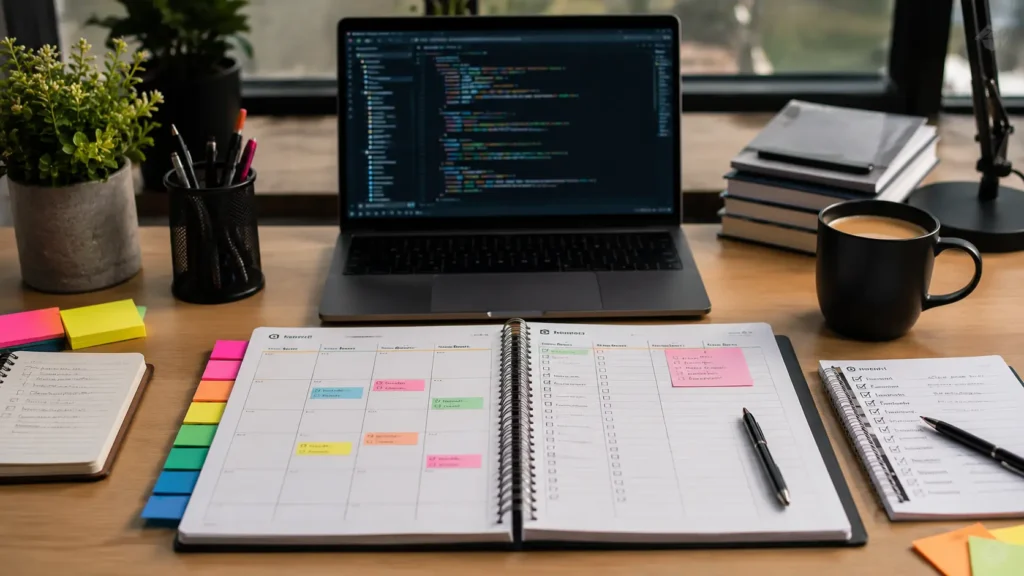
Starting with a clear plan makes learning programming much less overwhelming. Instead of jumping between random tutorials, focus on one goal at a time and build your skills gradually.
Remember that everyone learns at a different pace. If you need more time on a topic, that’s perfectly normal. The roadmap below is a general guide that you can adjust to fit your schedule.
Month 1: Learn the Fundamentals
The first month is all about understanding how programming works.
Focus on:
- Choosing one programming language (Python or JavaScript are popular beginner choices)
- Variables and data types
- Operators
- Conditional statements
- Loops
- Functions
- Basic debugging
Daily Routine
- Learn for 30-60 minutes.
- Write code every day, even if it’s only for a short time.
- Take notes on new concepts.
- Complete small exercises after each lesson.
Mini Projects
Practice by building simple programs such as:
- A calculator
- A number guessing game
- A temperature converter
- A basic to-do list
- A password generator
The goal isn’t perfection-it’s getting comfortable writing code on your own.
Month 2: Build Real Projects
Now that you understand the basics, start applying them to larger projects.
Learn About
- File handling
- APIs (if relevant to your language)
- Git and GitHub
- Error handling
- Basic object-oriented programming
- Code organization
Suggested Projects
- Personal portfolio website
- Weather app
- Expense tracker
- Quiz application
- Note-taking app
- Simple blog
- Calculator with a user interface
Each project will teach you something new and improve your confidence.
Month 3: Improve and Specialize
This is the stage where many learners begin creating portfolio-quality work.
Choose a direction based on your interests:
Web Development
Learn topics such as:
- Responsive design
- Front-end frameworks
- Back-end basics
- Databases
Python Development
Explore areas like:
- Automation
- Data analysis
- Web development
- Machine learning (beginner level)
Mobile Development
Continue with:
- Android
- iOS
- Cross-platform development
Build a Portfolio
Your portfolio should include:
- 4–6 completed projects
- Clear project descriptions
- GitHub repository links
- Screenshots
- Technologies used
- Lessons learned
A strong portfolio often demonstrates your practical skills better than simply listing completed courses.
Common Beginner Mistakes
Almost every programmer makes mistakes while learning. Recognizing them early can save you time and frustration.
1. Learning Too Many Languages at Once
It’s tempting to start Python, JavaScript, Java, and C++ all at the same time.
Don’t.
Master one language first before moving to another.
2. Watching Tutorials Without Coding
Watching someone else write code feels productive, but real learning happens when you write code yourself.
Pause videos frequently and recreate examples without copying them line by line.
3. Avoiding Real Projects
Projects teach lessons that tutorials can’t.
Even small projects help you understand:
- Debugging
- Planning
- Problem solving
- Code organization
4. Giving Up After Errors
Every programmer encounters errors.
Instead of becoming discouraged:
- Read the error message carefully.
- Search official documentation.
- Break the problem into smaller parts.
- Learn why the error occurred.
Debugging is a valuable programming skill.
5. Ignoring Documentation
Many beginners rely only on videos.
Professional developers regularly read documentation because it is usually the most accurate and up-to-date reference.
Learning how to use documentation will make you more independent.
6. Comparing Yourself to Others
Some people learn faster than others.
Focus on consistent improvement instead of comparing your progress with someone else’s journey.
Comparison Table: Best Free Programming Resources
| Resource | Best For | Interactive | Projects | Beginner Friendly |
| freeCodeCamp | Web development | Yes | Yes | Excellent |
| The Odin Project | Full-stack development | Partial | Yes | Excellent |
| Codecademy (Free Plan) | Interactive lessons | Yes | Limited | Excellent |
| Khan Academy | Absolute beginners | Yes | Some | Excellent |
| Harvard CS50 | Computer science fundamentals | Limited | Yes | Moderate |
| W3Schools | Quick references | Yes | Small examples | Excellent |
| MIT OpenCourseWare | Academic learning | No | Assignments | Moderate |
| Coursera (Audit) | University courses | Varies | Varies | Good |
| edX (Audit) | Structured learning | Varies | Varies | Good |
| HackerRank | Coding practice | Yes | Challenges | Good |
| LeetCode | Interview preparation | Yes | Challenges | Moderate |
| Codewars | Problem solving | Yes | Challenges | Good |
| Exercism | Mentored exercises | Yes | Exercises | Excellent |
Final Thoughts

Learning programming doesn’t require expensive courses or a computer science degree. What it does require is consistency, curiosity, and a willingness to practice.
The biggest advantage you have today is access to high-quality free learning resources. Instead of trying every platform, choose one structured course, complete the lessons, solve coding exercises, and build real projects.
Remember these key principles:
- Learn one programming language at a time.
- Write code every day, even if only for 30 minutes.
- Build projects regularly.
- Read official documentation.
- Use AI as a learning assistant-not a replacement for practice.
- Keep improving your portfolio as your skills grow.
Programming is a skill that develops through repetition. Every project, every bug you fix, and every concept you master brings you one step closer to becoming a confident developer.
Your Action Plan
If you’re ready to begin today, follow these simple steps:
- Choose one programming language based on your goals.
- Pick one structured learning platform, such as freeCodeCamp or The Odin Project.
- Set aside 30–60 minutes for coding each day.
- Create a GitHub account and save your projects there.
- Build one small project after every major topic you complete.
- Review your progress each month and identify areas to improve.
- Stay consistent, even if progress feels slow.
Small, consistent effort over time is far more effective than occasional bursts of intense study. Keep learning, keep building, and you’ll develop skills that can support personal projects, further education, freelancing, or a future career in software development.
Frequently Asked Questions
1. Can I learn programming completely for free?
Yes. Many excellent websites, books, videos, and official documentation are available at no cost. While paid courses can provide additional features or certificates, they are not required to build strong programming skills.
2. Which programming language should beginners learn first?
It depends on your goals.
- Python is often recommended for general programming, automation, and AI.
- HTML, CSS, and JavaScript are the standard starting point for web development.
Choose one path and stay consistent.
3. How long does it take to learn programming?
The answer varies based on your experience, study time, and goals.
With consistent practice, many beginners can understand the fundamentals within a few months. Becoming job-ready usually requires additional learning, regular practice, and a portfolio of projects.
4. Is YouTube enough to learn programming?
YouTube is an excellent learning resource, but videos alone are not enough.
To make real progress, combine tutorials with:
- Coding exercises
- Personal projects
- Official documentation
- Regular practice
5. Do I need a computer science degree?
Many developers have learned through online resources, personal projects, and practical experience. However, hiring requirements vary by employer and role, so continue developing both your technical skills and portfolio.
6. Which website is best for complete beginners?
freeCodeCamp, The Odin Project, Khan Academy, and Codecademy (Free Plan) are all strong starting points.
The best choice depends on your preferred learning style and career goals.
7. When should I start building projects?
Even simple projects reinforce programming concepts better than passive learning.
8. Should I use AI while learning programming?
AI tools can explain concepts and help you debug code, but avoid relying on them to solve every problem. Try writing your own solution first, then use AI to understand mistakes or explore alternatives.
9. How important is GitHub?
GitHub is an essential platform for many developers because it helps you:
- Store your code
- Track changes
- Share projects
- Build a public portfolio
- Collaborate with others
Learning Git and GitHub early is a worthwhile investment.